
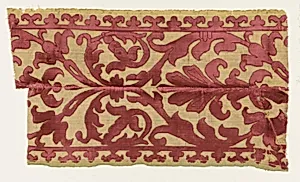
Fragment
Unknown Artist
17th century
Medium
Silk
Dimensions
Overall: 19 x 11 in. (48.3 x 27.9 cm)
Classification
Textiles-Velvets
Culture
Italian
Department
European Sculpture and Decorative Arts
Museum
Metropolitan Museum of Art, New York, NY
Credit
Gift of Nanette B. Kelekian, in honor of Olga Raggio, 2002
Accession Number
2002.494.459
Rights
Public Domain
Art Historical Context
This exquisite silk velvet fragment, hailing from 17th-century Italy, a tantalizing glimpse into the opulent world of Baroque-era textiles. Measuring 19 x 11 inches, it survives as a testament to the era's masterful craftsmanship, likely originating from renowned weaving centers like or Venice, where silk velv were prized for their sumptuous texture and vibrant sheen. Donated to the Metropolitan Museum of Art 2002 by Nanette B. Kelekian in honor of curator Olga Raggio, it in the European Sculpture andative Arts collection. Velvet production in Italy during this period involved intricate techniques: weaving a dense cut-pile surface on a silk foundation, which created a plush, light-reflecting quality ideal for lavish garments, ecclesiastical vestments, and furnishings. These textiles symbolized wealth and status, fueled by Italy's pivotal role in the Silk Road trade, blending Eastern luxury with European innovation. Though a mere fragment, it embodies the artistic pinnacle of Italian textile design—evoking the grandeur of princely courts and sacred spaces. Visitors, pause to admire how the velvet's subtle play of light reveals the weavers' skill, transporting you to a time when fabric was high art.