
Fragment
Unknown Artist
early 17th century
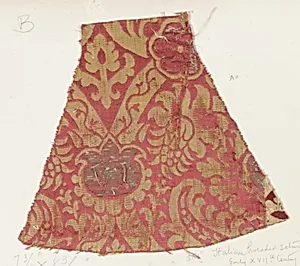
Medium
Silk, metal thread
Dimensions
Overall: 7 3/4 x 9 in. (19.7 x 22.9 cm)
Classification
Textiles-Woven
Culture
Italian
Department
European Sculpture and Decorative Arts
Museum
Metropolitan Museum of Art, New York, NY
Credit
Gift of Nanette B. Kelekian, in honor of Olga Raggio, 2002
Accession Number
2002.494.512
Rights
Public Domain
Art Historical Context
This exquisite silk and metal-thread fragment, woven in Italy during the early th century, offers a glimpse into the opulent world of Baroque-era textiles. Measuring just 7 3/4 x 9 inches, this small survivor from a larger textile—likely a luxurious cloth for ecclesiastical vestments, furnishings, or elite garments—showcases the masterful weaving techniques of Italian artisans. The use of shimmering metal threads intertwined with fine silk created a richly textured, light-reflecting surface, emblematic of the period's love for dramatic splendor and sensory indulgence. In the context of 17th-century Italy, such woven textiles represented the pinnacle of decorative arts, blending technical virtuosity with cultural prestige. Centers like Florence and Venice were renowned for producing these sumptuous fabrics, often incorporating gold or silver threads to evoke divine radiance in church settings or royal magnificence. The fragment's survival highlights the fragility of these treasures, preserved through meticulous conservation. Today, this piece graces the Metropolitan Museum of Art's European Sculpture and Decorative Arts collection, a generous gift from Nanette B. Kelekian in honor of Olga Raggio in 2002. It invites visitors to appreciate the anonymous craftsperson's skill, reminding us how textiles wove together art, faith, and fashion in Renaissance-to-Baroque Italy.