
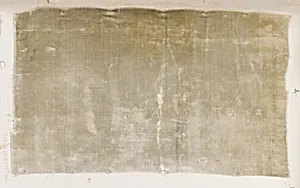
Fragment
Unknown Artist
17th–18th century
Medium
Silk
Dimensions
Overall: 8 3/8 x 14 in. (21.3 x 35.6 cm)
Classification
Textiles-Velvets
Culture
Italian
Department
European Sculpture and Decorative Arts
Museum
Metropolitan Museum of Art, New York, NY
Credit
Gift of Nanette B. Kelekian, in honor of Olga Raggio, 2002
Accession Number
2002.494.560
Rights
Public Domain
Art Historical Context
This exquisite silk velvet fragment, hailing from Italy in the 17th–18th century, offers a tantalizing glimpse into the opulent world of Baroque-era decorative arts. Measuring just 8 3/8 x 14 inches (21.3 x 35.6 cm), this delicate survivor—likely a remnant from a larger textile like upholstery, ecclesiastical vestments, or luxurious garments—showcases the mastery of Italian weavers. Displayed in the Metropolitan Museum of Art's Department of European Sculpture and Decorative Arts, it was generously gifted by Nanette B. Kelekian in honor of Olga Raggio in 2002. Velvet, with its signature short, plush pile created through a complex weaving technique involving cut loops, was a hallmark of luxury in Renaissance and Baroque Italy. Centers like Genoa and Venice produced these silks for elite clientele across Europe, prized for their rich texture, light-reflecting sheen, and ability to hold intricate patterns and dyes. Though the full design of this fragment remains a mystery due to its incomplete state, it embodies the technical virtuosity and material splendor that defined Italian textiles during a golden age of craftsmanship. As a classified Textile-Velvet, this piece highlights the cultural prestige of silk production in Italy, where such fabrics symbolized wealth, piety, and artistic innovation. Fragments like this preserve not just threads, but stories of trade, patronage, and daily splendor in a bygone era—inviting us to imagine the grand settings they once adorned.