
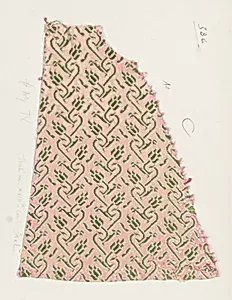
Fragment
Unknown Artist
17th–18th century
Medium
Silk
Dimensions
Overall: 8 1/4 x 6 1/2 in. (21 x 16.5 cm)
Classification
Textiles-Woven
Culture
Italian
Department
European Sculpture and Decorative Arts
Museum
Metropolitan Museum of Art, New York, NY
Credit
Gift of Nanette B. Kelekian, in honor of Olga Raggio, 2002
Accession Number
2002.494.579
Rights
Public Domain
Art Historical Context
This exquisite silk fragment, crafted by an unknown Italian artist in the 17th or 18th century, a glimpse into the opulent world of Baroque-era textiles. Measuring just 8¼ x 6½ inches (21 x 16.5 cm), it as a precious remnant, likely from a larger piece of luxury fabric used in clothing, furnishings, or ecclesiastical vestments. Housed in the Metropolitan Museum of Art's Department of European Sculpture and Decor Arts, it exemplifies the "Textiles-Woven" classification highlighting the mastery of silk weaving during Italy's golden age of textile production. Silk, prized for its luminous sheen and durability, was a cornerstone of Italian craftsmanship, with cities like Venice and Florence leading Europe's luxury trade. Weavers employed intricate loom techniques to create fine patterns, blending artistry with technical precision—a testament to the period's emphasis on sumptuous decoration amid the grandeur of the Counter-Reformation and absolutist courts. This fragment's survival underscores the fragility of such works, many lost to time or wear. Generously donated in 2002 by Nanette B. Kelekian in honor of curator Olga Raggio, it invites us to appreciate the tactile elegance of historical textiles, bridging centuries of cultural exchange and skilled labor.