
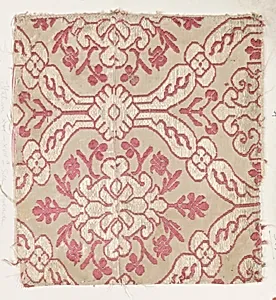
Fragment
Unknown Artist
16th–17th century
Medium
Silk, metal thread
Dimensions
Overall: 9 1/2 x 10 1/4 in. (24.1 x 26 cm)
Classification
Textiles-Woven
Culture
Italian
Department
European Sculpture and Decorative Arts
Museum
Metropolitan Museum of Art, New York, NY
Credit
Gift of Nanette B. Kelekian, in honor of Olga Raggio, 2002
Accession Number
2002.494.580
Rights
Public Domain
Art Historical Context
This exquisite silk and metal-thread fragment, woven in Italy during the 16 or 17th century, offers a glimpse into the opulent world of Renaissance and early Baroque decorative arts. Measuring 9½ x 10¼ inches (24.1 x 26 cm), this small survivor from a larger textile showcases the masterful weaving techniques of Italian artisans, who blended shimmering silk with metallic threads—likely gold or silver—for a luxurious, reflective sheen. Such fragments often came from grand furnishings, ecclesiastical vestments, or elite garments, highlighting Italy's dominance in textile production during this era. The use of metal threads in weaving was a hallmark of high-status Italian textiles, produced in weaving centers like Venice, Florence, and Genoa. These materials not only elevated the visual splendor but also symbolized wealth and piety, adorning palaces and churches alike. Woven on specialized looms, the intricate patterns would have demanded exceptional skill, reflecting the period's fusion of artistry and craftsmanship in the decorative arts. Today, this piece resides in The Metropolitan Museum of Art's Department of European Sculpture and Decorative Arts, a gift from Nanette B. Kelekian in honor of Olga Raggio in 2002. Though anonymous, it embodies the enduring allure of Italy's textile legacy, inviting us to imagine the vibrant courts and sacred spaces it once graced.