
Fragment
Unknown Artist
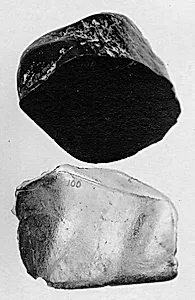
Medium
Nephrite
Dimensions
a) H. 2 5/8 in. (6.7 cm); W. 3 3/4 in. (9.5 cm); Th. 2 in. (5.1 cm) b) H. 2 5/8 in. (6.7 cm); W. 3 1/2 in. (8.9 cm); Th. 1/8 in. (.3 cm)
Classification
Jade
Culture
China (possibly Turkestan)
Department
Asian Art
Museum
Metropolitan Museum of Art, New York, NY
Credit
Gift of Heber R. Bishop, 1902
Accession Number
02.18.100a, b
Rights
Public Domain
Art Historical Context
This delicate fragment of nephrite jade, gifted to the Metropolitan Museum of Art in 1902 by Heber R. Bishop, offers a tantalizing glimpse into ancient Asian artistry. Comprising two pieces—a thicker slab measuring 2⅝ × 3¾ × 2 inches and a thinner one at 2⅝ × 3½ × ⅛ inch—the object hails from China, possibly Turkestan (modern-day Xinjiang region). Nephrite, prized for its creamy white to green hues and exceptional toughness, was a cornerstone of Chinese material culture, symbolizing purity, immortality, and imperial power. In ancient China, jade carving reached extraordinary heights, with artisans employing abrasion techniques using sand and water to shape the unyielding stone into ritual objects, ornaments, and burial goods. Though the exact date and purpose of this fragment remain unknown, its provenance suggests links to the Silk Road cultures of Central Asia, where nephrite from local mines influenced cross-cultural exchanges. Such fragments often survive from larger vessels or bi discs used in ceremonies. Displayed in the Asian Art department, this piece invites us to ponder the lost masterpiece it once complemented, highlighting jade's enduring allure as a bridge between the earthly and divine in Chinese cosmology.