
Fragment
Unknown Artist
14th–15th century
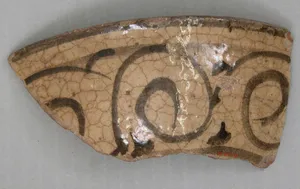
Medium
Earthenware; underglaze painted on white slip under transparent colorless glaze
Classification
Ceramics
Department
Islamic Art
Museum
Metropolitan Museum of Art, New York, NY
Credit
Rogers Fund, 1907
Accession Number
07.237.5
Rights
Public Domain
Art Historical Context
This enigmatic *Fragment* from the th–15th century a glimpse into the sophisticated world of Islamic ceramics, likely originating from workshops in Persia or the eastern Islamic lands during the Timurid era. Crafted from earthenware, it exemplifies the era's mastery of underglaze painting—a technique where pigments are applied to a white slip (a creamy clay layer) before firing under a transparent colorless glaze. method ensured vibrant, durable colors thatstood daily use, revolutionizing pottery production and distinguishing Islamic wares from earlier traditions. The fragment's preservation in the Metropolitan Museum of Art, thanks to the Rogers Fund of 1907, highlights its value as a testament to medieval Islamic artistry. Such pieces often featured intricate geometric patterns, floral motifs, or Arabic script, reflecting cultural values of harmony, spirituality, and technical innovation. Though incomplete, it invites us to imagine the grandeur of complete vessels used in homes, mosques, or palaces, bridging the artistry of the past with our modern appreciation for these enduring crafts.