
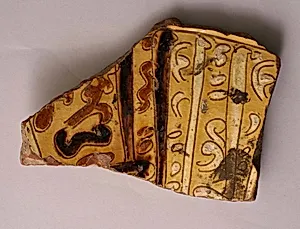
Fragment
Unknown Artist
14th–15th century
Medium
Earthenware; incised decoration through a white slip and coloring under transparent glaze
Classification
Ceramics
Department
Islamic Art
Museum
Metropolitan Museum of Art, New York, NY
Credit
Rogers Fund, 1907
Accession Number
07.237.11
Rights
Public Domain
Art Historical Context
This enchanting *Fragment* from the 14th–15th century offers a glimpse into the refined world of Islamic ceramics. Crafted from earthenware, it features intricate incised decoration carved through a white slip—a creamy layer applied over the clay—revealing the reddish body beneath. Vibrant coloring was then added before a transparent glaze sealed the design, creating a luminous, jewel-like effect that catches the light beautifully. In the Islamic art tradition, such techniques flourished across regions like Persia and the Levant, where potters innovated to mimic costly metalwork and textiles without using forbidden figural imagery. This sgraffito-style incising (from the Italian for "scratched") allowed for delicate patterns, possibly floral or geometric motifs symbolic of paradise gardens in Islamic culture. Though only a fragment survives, it exemplifies the era's technical mastery and aesthetic elegance, when ceramics became a canvas for everyday luxury. Acquired through the Rogers Fund in 1907, this piece now graces the Metropolitan Museum of Art's Islamic Art department, inviting visitors to ponder the anonymous artisan's skill and the vibrant trade networks that connected medieval Islamic worlds.