
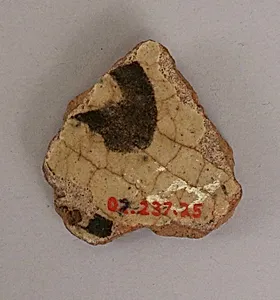
Fragment
Unknown Artist
14th–15th century
Medium
Earthenware; painted blue and black under clear transparent glaze, white slip
Classification
Ceramics
Department
Islamic Art
Museum
Metropolitan Museum of Art, New York, NY
Credit
Rogers Fund, 1907
Accession Number
07.237.25
Rights
Public Domain
Art Historical Context
This enigmatic *Fragment* from the th–15th century a glimpse into the sophisticated world of Islamic ceramics. Housed in the Metropolitan Museum of Art's Islamic department, this earthenware piece was acquired through the Rogers Fund in 7. Though its full form is lost to time—likely part of a larger vessel like a tile, bowl, or dish—it survives as a testament to the era's masterful craftsmanship in regions across the Islamic world. Crafted with white slip for a smooth, opaque base, the fragment features intricate blue and black paintings applied under a clear transparent glaze. This underglaze technique, fired to create a durable, lustrous finish, highlights the technical innovation of medieval Islamic potters. Blue, often derived from cobalt, was a prized color symbolizing the heavens and evoking luxury wares inspired by Chinese imports, while black added bold contrast for decorative motifs—perhaps floral or geometric patterns typical of the period. As a surviving relic, this fragment underscores the cultural flourishing of Islamic art during the Timurid and late Ilkhanid periods, where ceramics served both utilitarian and ornamental purposes in palaces, mosques, and homes. Visitors, pause to admire how such humble earthenware captured the elegance of an entire civilization's aesthetic ingenuity.