
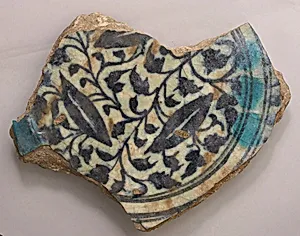
Fragment
Unknown Artist
14th–15th century
Medium
Stonepaste; underglaze turquoise and black; transparent, colorless glaze
Classification
Ceramics
Department
Islamic Art
Museum
Metropolitan Museum of Art, New York, NY
Credit
Rogers Fund, 1908
Accession Number
08.256.83
Rights
Public Domain
Art Historical Context
This enigmatic *Fragment* from the 14th–15th century exemplifies the exquisite ceramics of the Islamic world, likely originating from Persian workshops during a golden age of artistic innovation. Crafted from stonepaste—a composite of quartz, clay, and frit that mimicked Chinese porcelain's translucency while enabling intricate designs—this piece features underglaze decoration in vibrant turquoise and black, sealed beneath a transparent, colorless glaze. These techniques, perfected in centers like Kashan, produced durable, luminous wares prized for both utility and beauty. The fragment's bold motifs, though partial, reflect the era's fascination with geometric patterns and stylized flora, hallmarks of Islamic art that evoke infinity and harmony without figurative representation. Such ceramics adorned tableware, tiles, and architectural elements in mosques and palaces, symbolizing cultural exchange along the Silk Road. Acquired through the Rogers Fund in 1908, this survivor offers a glimpse into the technical mastery and aesthetic refinement of medieval Islamic artisans, whose innovations influenced global pottery traditions. (178 words)