
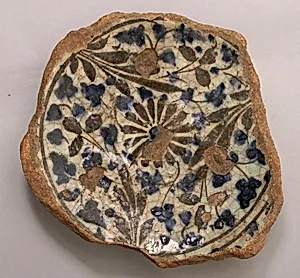
Fragment
Unknown Artist
15th century
Medium
Earthenware; incised decoration through a white slip and coloring under a transparent glaze.
Classification
Ceramics
Department
Islamic Art
Museum
Metropolitan Museum of Art, New York, NY
Credit
Rogers Fund, 1913
Accession Number
13.190.8
Rights
Public Domain
Tags
Art Historical Context
This exquisite *Fragment* from the 15th century offers a glimpse into the refined world of Islamic ceramics, likely produced in a workshop in Persia or the eastern Islamic lands. Crafted from earthenware, it exemplifies the era's mastery of pottery, where everyday vessels doubled as canvases for artistic expression. Acquired through the Rogers Fund in 1913 and now housed in the Metropolitan Museum of Art's Islamic Art Department, this piece survives as a testament to the durability and beauty of medieval craftsmanship. The artwork's technique is particularly noteworthy: artisans applied a white slip—a liquid clay layer—over the earthenware body, then incised delicate designs through it to reveal the reddish clay beneath. Vibrant coloring was added before firing under a transparent glaze, creating a luminous, jewel-like effect. Floral motifs, hinted at by the tags, were a hallmark of Islamic decoration, evoking paradise gardens from Quranic imagery and symbolizing renewal and abundance in a non-figural artistic tradition. Though only a fragment, it highlights the technical innovation and aesthetic elegance of 15th-century potters, bridging utility and opulence in Islamic culture. Visitors can appreciate how such ceramics adorned homes, mosques, and palaces, influencing global decorative arts.