
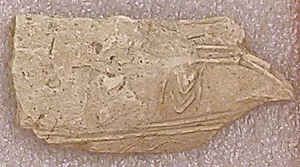
Fragment
Unknown Artist
8th–9th century
Medium
Earthenware; incised
Dimensions
H. 1 7/16 in. (3.7 cm) W. 3 1/16 in. (7.8 cm) D. 5/8 in. (1.6 cm) Wt. 0.6 oz. (17 g)
Classification
Ceramics
Department
Islamic Art
Museum
Metropolitan Museum of Art, New York, NY
Credit
Rogers Fund, 1932
Accession Number
32.150.446
Rights
Public Domain
Art Historical Context
This delicate earthenware fragment, dating to the 8th–9th century, a glimpse into the vibrant traditions of the early Islamic world, likely from regions like Iraq or Syria during the Abbasid Caliph. Measuring just 1 7/16 inches high and weighing a mere 0.6 ounces, it once belonged to a larger vessel—perhaps a bowl or dish used in daily life or for serving. Acquired through the Rogers Fund in 1932 and now housed in the Metropolitan Museum Art's Islamic Art department this tiny survivor speaks volumes about the ingenuity of artisans in an era of cultural flourishing. The piece exemplifies incised decoration, a technique where designs were meticulously scratched into the soft clay surface before firing. This method, prevalent in early Islamic ceramics before the advent of more elaborate glazing like lusterware, allowed for precise geometric or floral motifs that highlighted the pottery's natural earthen tones. Earthenware's accessibility made it ideal for both utilitarian objects and trade goods, spreading Islamic artistic influences across vast territories. Though incomplete, this fragment invites us to imagine the bustling workshops and diverse markets of the time, where such ceramics bridged functionality and subtle beauty. A testament to enduring craftsmanship, it reminds museum visitors of the Islamic world's profound contributions to global art history.