
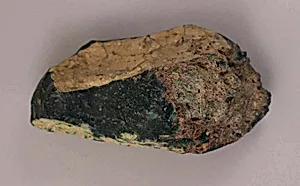
Fragment
Unknown Artist
9th century
Medium
Glass residue
Dimensions
H. 1 5/8 in. (4.1 cm) L. 3 3/8 in. (8.5 cm)
Classification
Glass
Department
Islamic Art
Museum
Metropolitan Museum of Art, New York, NY
Credit
Gift of Noel E. Baker, 1952
Accession Number
52.130.21
Rights
Public Domain
Art Historical Context
This delicate fragment, hailing from the 9th century, offers a tantalizing glimpse into the sophisticated world of Islamic glassmaking during the Abbasid era. Measuring just 1 5/8 inches high and 3 3/8 inches long, this small piece of glass residue—likely a remnant from a larger vessel such as a beaker or bottle—survives as a testament to the era's mastery of the medium. Housed in the Metropolitan Museum of Art's Islamic Art Department, it was generously gifted by Noel E. Baker in 1952. In the 9th century, Islamic artisans in regions like Syria, Egypt, and Mesopotamia revolutionized glass production, employing techniques such as free-blowing, molding, and cutting to create translucent luxury goods for elite patrons and international trade. While this fragment's exact form is lost to time, its preservation highlights the durability and ubiquity of glass in daily life, from tableware to mosque lamps. Such objects symbolized cultural refinement and technological prowess, often adorned with intricate patterns reflecting Islamic geometric motifs or floral designs. Though anonymous, this unassuming shard invites us to ponder the hands that shaped it amid the vibrant hubs of Baghdad or Damascus. It reminds visitors that even fragments hold stories of innovation and exchange across the medieval Islamic world.