
Fragment
Unknown Artist
9th–10th century
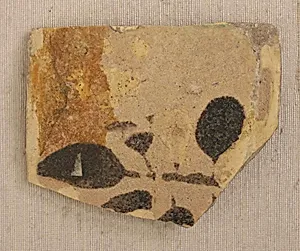
Medium
Earthenware; painted decoration
Classification
Ceramics
Department
Islamic Art
Museum
Metropolitan Museum of Art, New York, NY
Credit
Gift of Mr. and Mrs. Wendell M. Hastings, 1960
Accession Number
60.23.40
Rights
Public Domain
Art Historical Context
This delicate earthenware fragment, dating to the 9th–10th, offers a glimpse into the vibrant of early Islamic ceramics. Crafted during the Abbasid Caliph's golden age, when Baghdad was a hub of innovation and cultural exchange, such pieces were everyday vessels transformed into art through skilled painted decoration. Though incomplete, it exemplifies the technical prowess of potters who applied pigments—often in shades of blue, green, and manganese purple—directly onto the unfired clay before glazing and firing, creating durable, luminous surfaces. In the Department of Islamic Art at The Metropolitan Museum of Art, this fragment highlights the era's artistic ingenuity. Islamic ceramists pioneered underglaze painting techniques that influenced later traditions across the Middle East and beyond, favoring abstract motifs like geometrics, florals, and Kufic script over figurative imagery in line with cultural and religious preferences. These ceramics were not just functional but symbols of prosperity, traded along Silk Road routes and adorning homes from Mesopotamia to Spain. Gifted by Mr. and Mrs. Wendell M. Hastings in 1960, this modest survivor invites us to appreciate the anonymous artisans whose work bridged utility and beauty, preserving a fragment of medieval splendor for modern eyes.