
Fragment
Unknown Artist
8th–10th century
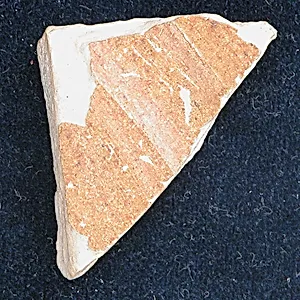
Medium
Stonepaste; slip painted and glazed
Dimensions
H. 7/16 in. (1.1 cm) W. 1 5/16 in. (3.3 cm) D. 1 3/8 in. (3.5 cm) Wt. 0.3 oz. (8.5 g)
Classification
Ceramics
Department
Islamic Art
Museum
Metropolitan Museum of Art, New York, NY
Credit
Gift of Mr. and Mrs. Wendell M. Hastings, 1960
Accession Number
60.23.75
Rights
Public Domain
Art Historical Context
This delicate ceramic fragment, dating to the 8th–10th century, hails from the Islamic world during a golden age of artistic innovation. Crafted from stonepaste—a composite of quartz, clay, and frit (ground glass)—it exemplifies early experiments in imitating the translucent sheen of Chinese porcelain, which was unavailable in the region. At just over 1 cm high and weighing a mere 0.3 oz, this tiny shard invites us to marvel at the precision of ancient artisans working on such a minuscule scale. The surface bears traces of slip painting, a technique where colored slips (liquid clay mixtures) were applied before a transparent glaze was fired, creating vibrant, durable decorations. This method flourished in centers like Iraq's Abbasid Baghdad or Samarra, where potters advanced glazing technologies that influenced ceramics across the Islamic realm and beyond. Though incomplete, the fragment hints at the geometric or vegetal motifs typical of the era, blending functionality with aesthetic splendor. Now housed in the Metropolitan Museum of Art's Department of Islamic Art, thanks to a 1960 gift from Mr. and Mrs. Wendell M. Hastings, it stands as a testament to enduring craftsmanship. Such survivals remind us how everyday objects from over a millennium ago continue to illuminate the ingenuity of medieval Islamic culture.