
Fragment
Unknown Artist
9th–10th century
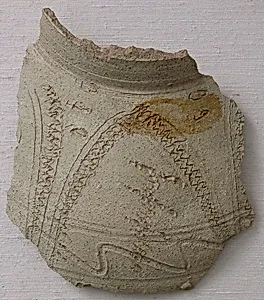
Medium
Earthenware; incised
Dimensions
H. 5 9/16 in. (14.1 cm) W. 5 1/8 in. (13 cm) D. 1 9/16 in. (4 cm) Wt. 6.2 oz. (175.8 g)
Classification
Ceramics
Department
Islamic Art
Museum
Metropolitan Museum of Art, New York, NY
Credit
Gift of Mr. and Mrs. Wendell M. Hastings, 1960
Accession Number
60.23.88
Rights
Public Domain
Art Historical Context
This delicate earthenware fragment, dating to the 9th–10th century, offers a glimpse into the refined world of early Islamic ceramics. Measuring just over 5 inches high and, it hails from the vibrant artistic traditions of the Islamic world during the Abbasid era, a time of cultural flourishing across the Middle East and beyond. As a modest survivor—likely part of a larger vessel or architectural element—its survival speaks to the enduring appeal of everyday artistry from over a millennium ago. Crafted from earthenware and adorned with incised decoration, the piece showcases a technique where designs were meticulously carved into the soft clay before firing. This method, prevalent in early Islamic pottery before the widespread adoption of colorful glazes, allowed artisans to create textured patterns that caught the light and added depth. Such incising often featured geometric motifs or calligraphy, reflecting the Islamic emphasis on abstraction and harmony. Housed in the Metropolitan Museum of Art's Department of Islamic Art, this fragment was generously gifted by Mr. and Mrs. Wendell M. Hastings in 1960. Though small, it embodies the ingenuity of anonymous craftspeople whose work influenced ceramics from Spain to Central Asia, inviting us to appreciate the beauty in fragments of history.