
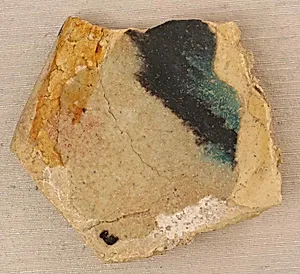
Fragment
Unknown Artist
9th–10th century
Medium
Earthenware; glazed
Classification
Ceramics
Department
Islamic Art
Museum
Metropolitan Museum of Art, New York, NY
Credit
Gift of Mr. and Mrs. Wendell M. Hastings, 1960
Accession Number
60.23.103
Rights
Public Domain
Art Historical Context
Nestled in the Metropolitan Museum of Art's Islamic collection, this unglazed earthenware fragment dates to the 9th–10th century, a era of the Abbasid Caliphate ceramic production flourished across the Islamic world, from Mesopotamia to Persia. As a modest survivor of time, it whispers of the artistry in everyday objects—likely a vessel or tile—crafted by an unknown potter whose skill endures. The medium of glazed earthenware marks a pivotal innovation in Islamic. Applying a glossy glaze not only sealed the porous clay for practical use but also created a luminous surface ideal for intricate decorations, often in turquoise blues or greens with geometric or floral motifs. This technique, refined during this period, influenced global pottery traditions and symbolized the era's mastery of kilns reaching high temperatures. Gifted to the Met in 1960 by Mr. and Mrs. Wendell M. Hastings, this fragment offers a tangible link to a vibrant cultural crossroads. It highlights how ceramics bridged trade routes, carrying Islamic aesthetic sophistication far beyond the Middle East, inviting us to ponder the hands that shaped it and the lives it once touched.