
Fragment
Unknown Artist
probably 11th century
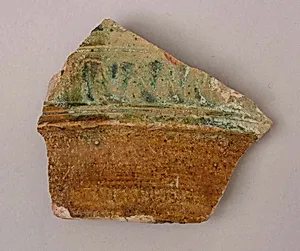
Medium
Earthenware; glazed
Classification
Ceramics
Department
Islamic Art
Museum
Metropolitan Museum of Art, New York, NY
Credit
Gift of Mr. and Mrs. Wendell M. Hastings, 1960
Accession Number
60.23.110
Rights
Public Domain
Art Historical Context
This enigmatic *Fragment* from the Metropolitan Museum of Art's Islamic Art collection invites us into the vibrant world of 11th-century ceramics. Crafted from earthenware and coated with a glossy glaze, this piece—likely part of a larger vessel or tile—survives as a testament to the ingenuity of anonymous artisans in the medieval Islamic world. Donated in 1960 by Mr. and Mrs. Wendell M. Hastings, it captures a moment when pottery production thrived across regions from Persia to North Africa. Glazing earthenware was a hallmark innovation of Islamic potters during this era, transforming humble clay into durable, waterproof objects adorned with shimmering surfaces. The technique, often using mineral-based glazes fired at high temperatures, allowed for intricate decorations while serving practical needs in households, mosques, and markets. Though details of its motifs are not specified, such fragments typically showcase the geometric patterns and stylized flora that defined Islamic aesthetic restraint and mathematical precision, influenced by religious and cultural norms. As a modest survivor, this fragment underscores the cultural significance of ceramics in Islamic societies—exported widely via trade routes, they symbolized luxury and technical mastery. It reminds us how everyday artistry bridged the gap between utility and beauty in a golden age of innovation.