
Fragment
Unknown Artist
probably 11th century
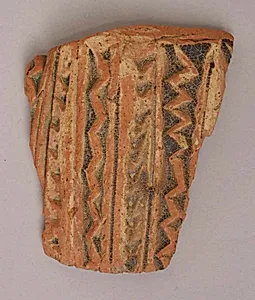
Medium
Earthenware; glazed
Classification
Ceramics
Department
Islamic Art
Museum
Metropolitan Museum of Art, New York, NY
Credit
Gift of Mr. and Mrs. Wendell M. Hastings, 1960
Accession Number
60.23.111
Rights
Public Domain
Art Historical Context
This delicate earthenware fragment, likely from the 11th century, offers a glimpse into the vibrant world of Islamic ceramics. Crafted by an unknown artist, it exemplifies the artistry of the medieval Islamic world, where pottery was both a practical craft and a canvas for aesthetic innovation. The glazed surface— a key technique perfected during this era—provided a smooth, durable finish that protected the earthenware while allowing for rich colors and intricate designs, often inspired by nature, geometry, or calligraphy. In the 11th century, Islamic potters, particularly in regions like Persia, Iraq, and Egypt under Fatimid or early Seljuk rule, advanced glazing methods that influenced global ceramics. This fragment survives as a testament to those technical achievements, highlighting how everyday objects became vehicles for cultural expression. Though incomplete, it evokes the splendor of mosque tiles, vessels, and tableware that adorned homes and public spaces. Generously gifted to the Metropolitan Museum of Art by Mr. and Mrs. Wendell M. Hastings in 1960, this piece invites us to ponder the anonymous hands behind Islamic art's enduring legacy—where beauty thrived in simplicity and skill. (198 words)