
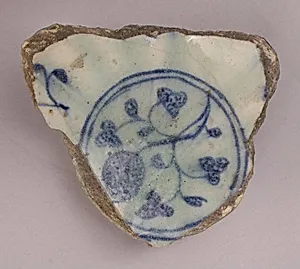
Fragment
Unknown Artist
13th–16th century
Medium
Stonepaste; painted under transparent glaze
Classification
Ceramics
Department
Islamic Art
Museum
Metropolitan Museum of Art, New York, NY
Credit
Gift of Jack A. Josephson, 1973
Accession Number
1973.79.48
Rights
Public Domain
Art Historical Context
This delicate ceramic fragment, dating from the 13th to 16th century, offers a glimpse into the sophisticated world of Islamic art. Crafted from stonepaste—a composite material of quartz, clay, and frit developed by artisans in the Islamic world—this piece exemplifies a technical innovation that mimicked the prized porcelain of China while allowing for vibrant, durable designs. Housed in the Metropolitan Museum of Art's Art department, it was generously gifted by Jack A. Josephson in 1973. The artwork's medium shines through its painted decoration under a transparent glaze, a masterful technique perfected in regions like Iran, Syria, and Egypt during the medieval and early modern periods. Artisans applied pigments directly onto the unfired stonepaste body before glazing and firing it at high temperatures, ensuring colors remained vivid and protected. This method enabled intricate motifs—often floral, geometric, or calligraphic—that symbolized paradise gardens, spiritual harmony, and the boundless creativity of Islamic culture. Though just a fragment, it whispers of grander vessels or tiles adorning mosques, palaces, and homes, reflecting the era's flourishing trade, patronage, and artistic exchange across the Silk Road. A testament to anonymous mastery, it invites us to marvel at the enduring beauty of everyday luxury in the Islamic golden age.