
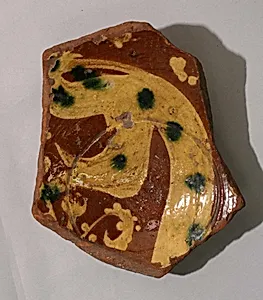
Fragment
Unknown Artist
14th–15th century
Medium
Earthenware; slip-painted
Classification
Ceramics
Department
Islamic Art
Museum
Metropolitan Museum of Art, New York, NY
Credit
Rogers Fund, 1908
Accession Number
08.256.154
Rights
Public Domain
Art Historical Context
This delicate earthenware fragment, dating to the 14th–15th century, offers a tantalizing glimpse into the vibrant of Islamic ceramics. Housed in the Metropolitan Museum of Art's Islamic department and acquired through the Rogers Fund in 190, it exemplifies the craftsmanship of anonymous artisans from the medieval Islamic world, where pottery flourished as both utilitarian and artistic expression. The medium—slip-painted earthenware—highlights a masterful technique central to Islamic pottery production. Artisans applied liquid clay slips, often pigmented, in trailing lines or motifs onto the unfired surface, creating intricate patterns before a final firing. This method allowed for bold colors and elaborate designs without relying on costly materials like metal or glass, making ceramics accessible yet exquisitely refined. Such fragments often came from vessels, tiles, or architectural elements, preserving echoes of daily life and splendor. In the context of the 14th–15th centuries—a golden age bridging Mongol influences and the rise of Timurid patronage—this piece underscores the cultural importance of ceramics in Islamic societies. They served as canvases for geometric, floral, and calligraphic motifs, reflecting spiritual and aesthetic ideals. Though incomplete, this fragment invites us to appreciate the enduring legacy of these skilled hands.