
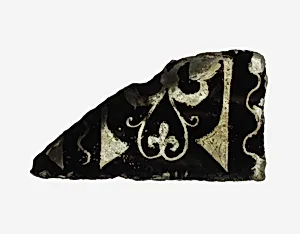
Fragment
Unknown Artist
15th century
Medium
Pot-metal glass and vitreous paint
Dimensions
1 1/2 × 2 11/16 × 3/16 in. (3.8 × 6.8 × 0.4 cm)
Classification
Glass-Stained
Culture
European
Department
Medieval Art
Museum
Metropolitan Museum of Art, New York, NY
Credit
Gift of George D. Pratt, 1930
Accession Number
30.73.84
Rights
Public Domain
Art Historical Context
This delicate *Fragment* from 15th-century Europe exemplifies the luminous artistry of medieval stained glass, a medium that transformed cathedrals into glowing narratives of faith and beauty. Crafted by an unknown artist, this tiny piece—measuring just 1 1/2 × 2 11/16 inches—survives as a testament to the grandeur of larger Gothic windows, many of which were lost to time, war, or architectural changes. Housed in the Metropolitan Museum of Art's Medieval Art department since its 1930 gift from George D. Pratt, it invites us to ponder the vibrant panels that once filtered sunlight through sacred spaces. The artwork employs *pot-metal glass*, where metallic oxides like copper or cobalt are fused into molten glass to create rich, translucent colors that endure without fading. Details are added with *vitreous paint*—a glassy enamel fired onto the surface—allowing fine lines and shading that brought biblical scenes or saints to life. This labor-intensive technique, perfected in northern European workshops during the late Middle Ages, highlighted the era's fusion of craftsmanship, spirituality, and optical innovation. Though its exact subject remains a mystery, this fragment captures the cultural zenith of stained glass as "poor man's Bible," illuminating stories for the illiterate masses. It reminds visitors of medieval Europe's devotion to light as divine metaphor, preserved for modern awe.