
Fragment
1830/50
Medium
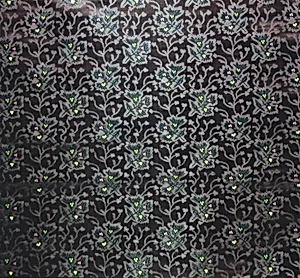
Silk, warp-float faced satin weave with supplementary patterning warps and self-patterned by ground weft floats and areas of plain weve; woven on loom with Jacquard attachment
Dimensions
105.7 × 51.7 cm (41 5/8 × 20 3/8 in.); Repeat: 6.8 × 8.3 cm (2 3/4 × 3 1/4 in.)
Classification
textile
Department
Textiles
Museum
Art Institute of Chicago
Accession Number
77596
Rights
Public Domain
Art Historical Context
This striking silk fragment, created by Gertrude Rapp between 1830 and 1850, offers a fascinating glimpse into the early years of mechanized textile design. Woven on a loom equipped a Jacquard attachment, the piece demonstrates the revolutionary technology that transformed pattern weaving in the nineteenth century. Its intricate structure—featuring warp-float faced satin weave, supplementary patterning warps, and self-patterned areas—reveals the precision and complexity possible even in a relatively small textile sample. The medium itself highlights a pivotal moment in textile history. The Jacquard system, introduced in the early 1800s, used punched cards to control individual threads, enabling elaborate motifs without the labor-intensive drawloom process. Rapp’s fragment, measuring just over three feet long, likely served as a design study or remnant from a larger furnishing or garment fabric, showcasing the luxurious sheen of silk combined with innovative patterning techniques. Today, this work stands as a testament to the artistry and technical skill of mid-nineteenth-century weavers. Its presence in the Art Institute of Chicago’s textile collection invites visitors to appreciate how industrial innovation and traditional craftsmanship merged to create fabrics of remarkable beauty and durability.