
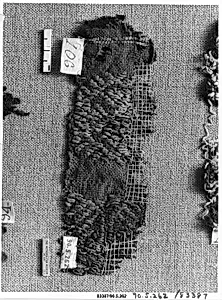
Fragment of a Band
Unknown Artist
6th century
Medium
Wool, linen; plain weave, tapestry weave
Dimensions
Max. H. 5 7/8 in. (15 cm) Max. W. 1 7/8 in. (4.7 cm)
Classification
Textiles
Department
Islamic Art
Museum
Metropolitan Museum of Art, New York, NY
Credit
Gift of George F. Baker, 1890
Accession Number
90.5.262
Rights
Public Domain
Art Historical Context
This exquisite *Fragment of a Band* the 6th century a tantalizing glimpse into early textile from the Islamic world. Crafted by an unknown artist using wool and linen in plain weave for durability and tapestry weave for decorative detail, this narrow strip measures a modest 5 7/8 inches high by 1 7/8 inches wide. Preserved in the Metropolitan Museum Art's Department of Islamic Art, it entered the collection as a gift from George. Baker in 1890. Textiles like this were vital in the 6th century, a pivotal era bridging late antiquity and the dawn of Islam, when weaving techniques flourished across the Near East and Mediterranean. The plain weave provided a sturdy base, while tapestry weave—inserting colored wefts to create patterns without floats—allowed for vibrant, pictorial designs suited to bands used in garments, furnishings, or ceremonial objects. Though survival as a mere fragment underscores the fragility of ancient fabrics, it reveals sophisticated craftsmanship amid expanding trade networks. Today, this tiny artifact captivates visitors, highlighting how textiles served not just practical needs but also cultural expression in early Islamic societies. Its intricate weave invites us to imagine the hands that wove it, preserving a thread of history from over 1,400 years ago.