
Fragment of a Band
Unknown Artist
5th–6th century
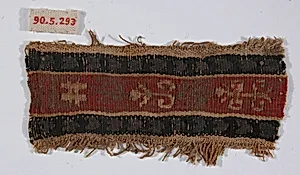
Medium
Wool, linen; plain weave, tapestry weave
Dimensions
Max. H. 3 9/16 in. (9.1 cm) Max. W. 1 1/4 in. (3.2 cm)
Classification
Textiles
Department
Islamic Art
Museum
Metropolitan Museum of Art, New York, NY
Credit
Gift of George F. Baker, 1890
Accession Number
90.5.293
Rights
Public Domain
Art Historical Context
This delicate *Fragment of a Band*, to the 5th–6th century, offers a glimpse into the sophisticated textile traditions of the early Islamic world. Crafted from wool and linen plain weave and tapestry weave techniques, this artifact—measuring just 3 9/16 inches high and 1 1/4 inches wide— formed part of a larger decorative band on clothing, furnishings, or ceremonial objects. Such fragments are rare survivors, preserved through the arid climates of the Middle East, highlight the region's pivotal role in ancient trade networks linking the Mediterranean, Persia, and beyond. The dual weaving methods showcase masterful craftsmanship: plain weave provided a sturdy base, while tapestry weave allowed for intricate, pictorial designs woven directly into the fabric without additional seams. In the Islamic Art department of the Metropolitan Museum of Art, this piece exemplifies early textile innovation, where vibrant colors and motifs reflected cultural exchanges during Late Antiquity. Textiles like this were prized luxury goods, symbolizing wealth and artistry in pre-Islamic and emerging Islamic societies. A generous gift from George F. Baker in 1890, it invites visitors to marvel at how everyday materials could convey profound cultural narratives across millennia.