
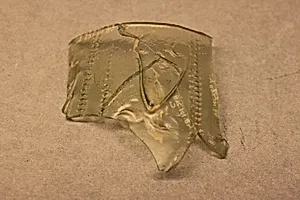
Fragment of a Beaker
Unknown Artist
9th–10th century
Medium
Glass, greenish colorless; pinched
Dimensions
Max. dim. assembled: H. 2 9/16 in. (6.5 cm) W. 2 3/4 in. (7 cm)
Classification
Glass
Department
Islamic Art
Museum
Metropolitan Museum of Art, New York, NY
Credit
Rogers Fund, 1948
Accession Number
48.101.268a–c
Rights
Public Domain
Art Historical Context
This delicate fragment of a beaker, dating to the 9th–10th century, a glimpse into the refined glassmaking traditions of the Islamic during the Abbasid era. Crafted from greenish colorless glass—a hue achieved through natural impurities in the silica—the piece measures just 2 9/16 inches (6.5 cm) high and 2 3/4 inches (7 cm) wide when assembled. As a survivor from everyday luxury vessels, it highlights the ubiquity of glass in medieval Islamic households, where such items held water, perfumes, or oils. The "pinched" technique used here is particularly noteworthy. Artisans heated molten glass and shaped it by pinching with tools, creating thin-walled forms without molds or blowing. This labor-intensive method allowed for precise control, producing lightweight, elegant beakers prized for their transparency and subtle color. Common across Syria, Iraq, and Egypt, these vessels exemplified Islamic artisans' mastery of glass, rivaling metalwork in sophistication and often exported along trade routes. Now in the Metropolitan Museum of Art's Islamic Art Department (acquired via the Rogers Fund in 1948), this fragment evokes the vibrant material culture of a golden age of innovation, reminding us how fragile artifacts preserve stories of ancient craftsmanship.