
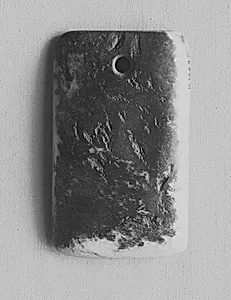
Fragment of a blade
Unknown Artist
late 19th to early 20th century
Medium
Jade
Dimensions
H. 2 1/8 in. (5.4 cm); W. 3 1/2 in. (8.9 cm)
Classification
Jade
Culture & Period
China · Qing dynasty (1644–1911)
Department
Asian Art
Museum
Metropolitan Museum of Art, New York, NY
Credit
Gift of Samuel T. Peters. 1916
Accession Number
16.144.9
Rights
Public Domain
Art Historical Context
This delicate fragment of a jade blade, crafted in China during the late Qing dynasty (1644–1911), offers a glimpse into the refined artistry of the era's final decades. Measuring just 2 1/8 inches high and 3 1/2 inches wide, this small piece—likely part of a larger ceremonial dagger or ritual object—showcases the prized nephrite jade, a material revered in Chinese culture for its luminous translucency and symbolic ties to purity, immortality, and imperial virtue. Acquired as a gift to the Metropolitan Museum of Art in 1916 by Samuel T. Peters, it now resides in the Asian Art department. Jade carving reached extraordinary heights in the Qing period, with artisans employing meticulous techniques like incising, drilling, and polishing to reveal the stone's natural veining and subtle green hues. Though incomplete, this blade fragment hints at the object's original function: possibly a symbolic weapon for court rituals or burial offerings, where jade transcended utility to embody spiritual power and status. Such works reflect the dynasty's blend of tradition and innovation, as carvers drew on millennia-old motifs amid political upheaval. Visitors will appreciate how this unassuming relic captures jade's enduring allure in Chinese aesthetics—cool to the touch yet warm in cultural resonance—inviting reflection on an empire's twilight.