
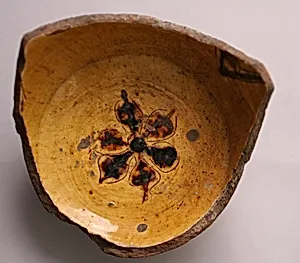
Fragment of a Bowl
Unknown Artist
14th–15th century
Medium
Earthenware; incised decoration through white slip and coloring under transparent glaze
Dimensions
H. 3 1/16 in. (7.8 cm) W. 6 in. (15.3 cm) D. 6 in. (15.2 cm)
Classification
Ceramics
Department
Islamic Art
Museum
Metropolitan Museum of Art, New York, NY
Credit
Rogers Fund, 1908
Accession Number
08.256.90
Rights
Public Domain
Tags
Art Historical Context
This delicate fragment of a bowl, crafted in the 14th–15th, offers a glimpse into the refined world of Islamic ceramics. Made from earthenware, it features intricate incised decoration carved through a white slip layer with added coloring beneath a transparent glaze. This technique, known as sgraff, creates striking contrasts and depth, revealing the underlying clay for a textured, luminous effect. Measuring just over 3 inches high and6 inches across, the fragment preserves floral motifs—likely blooming flowers—that evoke the natural beauty celebrated in Islamic art. Produced during a golden age of Islamic pottery in regions like Persia or Syria, such bowls were everyday vessels transformed into art through skilled craftsmanship. The white slip and glazing mimicked costly Chinese porcelain, a nod to cultural exchange along trade routes. Floral designs symbolized paradise gardens in Islamic tradition, blending utility with spiritual resonance. Though only a fragment, acquired via the Rogers Fund in 1908, it highlights the Metropolitan Museum of Art's Islamic collection. These ceramics showcase technical innovation and aesthetic elegance, inviting us to appreciate the anonymous artisans who elevated humble clay into timeless beauty.