
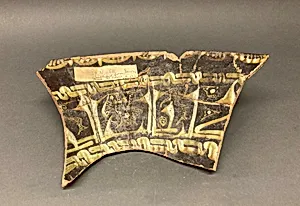
Fragment of a Bowl
Unknown Artist
9th–10th century
Medium
Earthenware; dark brown slip, greenish glaze
Dimensions
H. 10 1/16 in. (25.6 cm) W. 10 3/16 in. (25.8 cm)
Classification
Ceramics
Department
Islamic Art
Museum
Metropolitan Museum of Art, New York, NY
Credit
Rogers Fund, 1940
Accession Number
40.170.475
Rights
Public Domain
Art Historical Context
This exquisite fragment of a bowl, dating to the 9th–10th century, offers a glimpse into the vibrant of early Islamic ceramics. Crafted during the Abbasid Caliphate's golden age, when Baghdad was a hub of innovation and trade, such vessels were everyday luxuries in households across the Islamic world, from Mesopotamia to Persia. Though only a portion survives—measuring about 10 inches high and wide—it hints at the original bowl's graceful form, likely used for serving food or displaying fruits. Made of earthenware, the piece showcases sophisticated techniques: a dark brown slip painted over the body and coated with a shimmering greenish glaze. Earthenware was the backbone of Islamic pottery production, fired at lower temperatures than stoneware, making it accessible yet refined. The slip created decorative contrasts, while the copper-derived green glaze—lustrous and translucent—protected the surface and added an iridescent beauty prized in markets from Spain to Central Asia. This method reflected technological advances borrowed from Chinese influences via the Silk Road. As part of the Metropolitan Museum of Art's Islamic Art collection (acquired via the Rogers Fund in 1940), this fragment underscores ceramics' cultural role: not just functional, but symbols of prosperity and artistry in a faith that favored geometric and floral motifs over human figures. Imagine it once gracing a merchant's table, bridging East and West.