
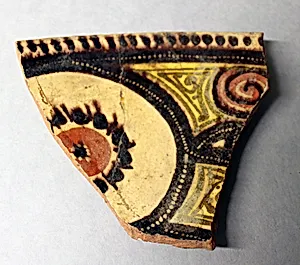
Fragment of a Bowl
Unknown Artist
9th–10th century
Medium
Earthenware; red body, white slip with manganese brown, red and yellow-black decoration under glaze
Dimensions
H. 4 3/16 in. (10.7 cm) W. 4 15/16 in. (12.5 cm) Thickness. 1/4 in. (0.7 cm)
Classification
Ceramics
Department
Islamic Art
Museum
Metropolitan Museum of Art, New York, NY
Credit
Rogers Fund, 1940
Accession Number
40.170.476
Rights
Public Domain
Art Historical Context
This delicate fragment of a bowl, dating to the 9th–10th century, a glimpse into the vibrant of Islamic ceramics during a golden age of artistic innovation. Crafted from earthenware with a distinctive red body, it exemplifies technical sophistication of potters in regions like Iraq or Persia under the Abbasid Caliphate. Such vessels were everyday objects—used for serving food or water—yet elevated by skilled decoration, reflecting the Islamic emphasis on beauty in utilitarian arts. The bowl's surface features a white slip painted with manganese brown, red, and yellow-black motifs, all fired under a glaze for durability and luster. This underglaze technique was revolutionary, allowing bold colors to fuse permanently with the clay, resisting wear from daily use. Unlike fragile glass or costly metalware, earthenware made ornate designs accessible, blending functionality with aesthetic splendor often inspired by nature or geometry, in keeping with Islamic aniconism. Though only a small piece (just over 4 inches high and wide), it survives as a testament to ancient craftsmanship, acquired through the Rogers Fund in 1940 for the Metropolitan Museum of Art's Islamic Art collection. Visitors can appreciate how these fragments preserve the ingenuity of forgotten artisans, bridging centuries of cultural exchange along Silk Road trade routes.