
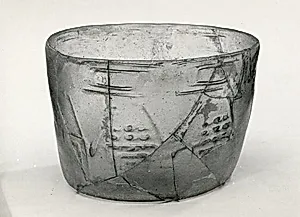
Fragment of a Bowl
Unknown Artist
9th–10th century
Medium
Glass, green; cut
Dimensions
H. ca. 2 3/4 in. (7.0 cm) Diam. (base) ca. 3 1/4 in. (8.3 cm)
Classification
Glass
Department
Islamic Art
Museum
Metropolitan Museum of Art, New York, NY
Credit
Rogers Fund, 1948
Accession Number
48.101.57
Rights
Public Domain
Art Historical Context
This delicate fragment of a green glass bowl, dating to the 9th–10th century, offers a glimpse into the sophisticated world of Islamic glassmaking. Crafted during a golden age of the Abbasid Caliphate or early Fatimid era, when artisans across the Islamic world excelled in producing translucent vessels for daily use and display, this piece survives as a testament to enduring craftsmanship. Its petite size—about 2¾ inches high with a 3¼-inch base diameter—suggests it was part of a larger, elegant bowl, likely used for serving food or beverages in affluent households. The green hue, achieved through natural impurities like copper in the glass formula, glows with subtle warmth, while the "cut" technique reveals masterful precision. Artisans used grinding wheels or abrasives to incise facets or patterns into the surface, creating sparkling light effects and intricate designs that elevated simple glass to luxury status. This labor-intensive method, popular in regions like Syria, Egypt, and Iraq, highlighted the technical prowess of Islamic workshops, which rivaled and influenced Byzantine and European glass traditions. Though incomplete, this fragment from the Metropolitan Museum of Art's Islamic Art collection underscores the cultural exchange along Silk Road trade routes, where glassware symbolized refinement and innovation. Acquired through the Rogers Fund in 1948, it invites us to appreciate how everyday objects carried profound artistic value in medieval Islamic society.