
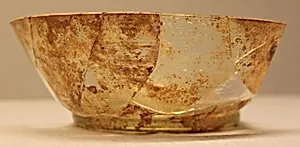
Fragment of a Bowl
Unknown Artist
10th–11th century
Medium
Glass, greenish; free blown
Dimensions
H. 2 5/8 in. (6.6 cm) Diam. (at base). 4 9/16 in. (11.6 cm)
Classification
Glass
Department
Islamic Art
Museum
Metropolitan Museum of Art, New York, NY
Credit
Rogers Fund, 1948
Accession Number
48.101.281
Rights
Public Domain
Art Historical Context
This delicate fragment of a greenish glass bowl, dating to 10th–11th century, a glimpse into the sophisticated world of Islamic artisanship. Crafted during the height of the Islamic Golden Age, when trade and cultural exchange flourished across the Middle East, North Africa, and beyond, vessels were common in households and served practical yet elegant purposes for food and drink. Though only a partial survivor—standing just 2⅝ inches high with a base diameter of 4⁹⁄₁₆ inches—it evokes the graceful curves and subtle translucency prized in medieval Islamic tableware. The bowl's free-blown technique marks a pinnacle of glassmaking innovation. Developed in the Islamic world around the 9th century, free blowing involved gathering molten glass on a blowpipe and inflating it into lightweight, thin-walled forms without molds. The natural greenish hue, likely from iron impurities in the silica, was typical and lent an organic warmth to these objects, which ranged from everyday items to luxurious exports. This method allowed for fluid shapes impossible in earlier cast or molded glass, highlighting the era's technical mastery. Preserved through the Rogers Fund at The Metropolitan Museum of Art since 1948, this fragment underscores the enduring legacy of Islamic glasswork. It reminds us how fragile artifacts bridge us to vibrant past cultures, where beauty infused the mundane.