
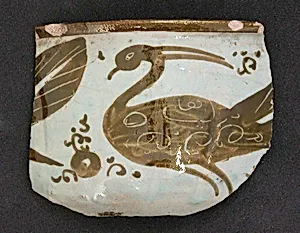
Fragment of a Bowl
Unknown Artist
10th–12th century
Medium
Stonepaste; luster-painted
Dimensions
Gr. H. 3 1/8 in. (7.9 cm) Gr. W. 3 11/16 in. (9.4 cm)
Classification
Ceramics
Department
Islamic Art
Museum
Metropolitan Museum of Art, New York, NY
Credit
Fletcher Fund, 1975
Accession Number
1975.31.8
Rights
Public Domain
Tags
Art Historical Context
This exquisite fragment of a bowl, dating from the 10th to 12th century, hails from the Islamic world and showcases the pinnacle of medieval ceramic innovation. Crafted in stonepaste—a composite material of quartz, clay, and frit that allowed artisans to create a fine, porcelain-like body—this piece measures just 3 1/8 inches high and 3 11/16 inches wide. Now housed in the Metropolitan Museum of Art's Art Department (acquired via the Fletcher Fund in 197), it survives as a testament to the era's technical mastery and aesthetic refinement. The standout feature is its luster-painting technique, where metallic oxides were applied over a glazed surface and fired in a reducing atmosphere to produce a shimmering, iridescent glow reminiscent of precious metals or Chinese porcelain imports. Delicate motifs, likely including birds as suggested by its tags, adorned such vessels, evoking themes of nature and paradise gardens central to Islamic decorative arts. These bowls were prized luxury items, used in elite households and reflecting cross-cultural exchanges along Silk Road trade routes. Though only a fragment remains, it captures the vibrancy of Abbasid or Seljuk-era pottery workshops, where potters pushed boundaries to rival glass and metalwork. A small survivor, it invites us to imagine the full vessel's luminous beauty under candlelight.