
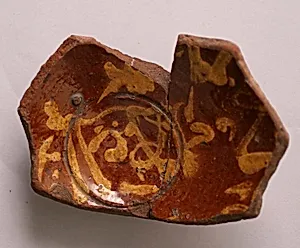
Fragment of a Bowl
Unknown Artist
14th–15th century
Medium
Earthenware; slip-painted under transparent glaze
Dimensions
H. 1 5/8 in. (4.2 cm) W. 4 7/16 in. (11.3 cm) D. 3 5/8 in. (9.2 cm) Th. 1/4 in. (0.7 cm)
Classification
Ceramics
Department
Islamic Art
Museum
Metropolitan Museum of Art, New York, NY
Credit
Rogers Fund, 1908
Accession Number
08.256.290
Rights
Public Domain
Art Historical Context
This charming fragment of a bowl, from the 14th–15th century Islamic world, invites us to imagine the pottery workshops of that era. Though only a small piece survives—measuring just 1 5/8 inches high and 4 7/16 inches wide—it hints at the refined ceramics produced across regions like Persia and the Near East during a time of cultural flourishing under dynasties such as the Timurids and Mamluks. Acquired through the Rogers Fund in 8, it now graces the Metropolitan Museum of Art's Department of Islamic Art, preserving a slice of everyday elegance. Crafted from earthenware, the bowl was decorated using slip-painting—a skilled technique where liquid clay (slip) was trailed or brushed to form patterns, then fired under a transparent glaze. This method created durable, lustrous surfaces that protected intricate designs while allowing colors to glow vividly. Common in Islamic ceramics, it democratized beauty, adorning tableware for homes and mosques alike, blending functionality with artistry. As a testament to medieval Islamic ingenuity, this fragment underscores the era's mastery of low-fired clays and glazes, techniques that influenced global ceramics. Though incomplete, it sparks curiosity about the full vessel's motifs—likely floral or geometric—and the hands that shaped it centuries ago.