
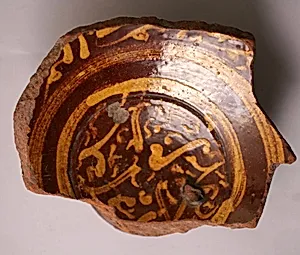
Fragment of a Bowl
Unknown Artist
14th–15th century
Medium
Earthenware; slip-painted under transparent glaze
Classification
Ceramics
Department
Islamic Art
Museum
Metropolitan Museum of Art, New York, NY
Credit
Rogers Fund, 1913
Accession Number
13.190.153
Rights
Public Domain
Art Historical Context
This exquisite fragment of a bowl, by an unknown artist in the14th–15th, offers a glimpse into the vibrant of Islamic ceramics. Hailing from the Islamic Art collection at the Metropolitan Museum of—acquired through the Rogers Fund in 191—it exemplifies the technical mastery of potters during a golden age of Persian and Syrian pottery production. These centuries saw flourishing trade routes and court patronage, fueling innovations in earthenware that blended utility with artistry. The bowl's medium—earthenware decorated with slip-painted designs under a transparent glaze—highlights a signature Islamic technique. Slip, a liquid clay mixture, was applied to create intricate motifs before firing, then sealed with a glossy glaze that preserved vivid colors and protected the surface. This method allowed for bold geometric patterns, floral motifs, and calligraphy, reflecting the era's reverence for beauty in everyday objects. Though only a fragment survives, it whispers of opulent dining halls and bustling bazaars. As a testament to enduring cultural heritage, this piece underscores Islam's profound influence on global ceramics, bridging East and West through shared aesthetic ideals. Visitors, imagine holding a shard that once held spices or shared meals—history in your hands!