
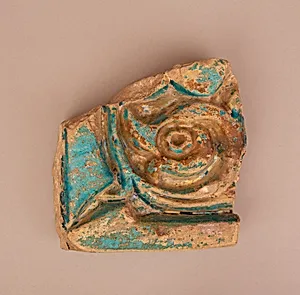
Fragment of a Carved or Molded and Glazed Tile
Unknown Artist
12th century
Medium
Earthenware; turquoise glaze
Dimensions
Ht. 6 5/16 in. (16 cm) W. 6 15/16 in. (17.6 cm) D. 2 3/16 in. (5.6 cm)
Classification
Ceramics
Department
Islamic Art
Museum
Metropolitan Museum of Art, New York, NY
Credit
Rogers Fund, 1948
Accession Number
48.101.93
Rights
Public Domain
Art Historical Context
This exquisite fragment of a carved or molded earthenware tile, glazed in vibrant turquoise, hails from the 12th century offers a glimpse into the splendor of Islamic architectural decoration. Measuring just over 6 inches square, it likely once adorned the walls or domes of a mosque, palace, or madrasa in the Islamic world, where such tiles transformed sacred and secular spaces into shimmering mosaics of light and color. The turquoise glaze, a hallmark medieval Islamic ceramics particularly from regions like Iran and Central Asia during the Seljuk era, achieved by firing earthenware at high temperatures with mineral pigments. This technique not only provided a durable, waterproof surface but also created a luminous luster that evoked the heavens—symbolizing paradise in Islamic art. Whether carved by incising designs into the unfired clay or molded in relief, the tile's textured surface would have caught the play of light, enhancing intricate geometric or floral motifs typical of the period. Though a modest fragment, it embodies the ingenuity of anonymous artisans whose work elevated everyday architecture to divine artistry. Acquired through the Rogers Fund in 1948, this piece at the Metropolitan Museum of Art invites us to imagine the grand ensembles it once joined, whispering tales of a golden age of Islamic craftsmanship.