
Fragment of a Dish
Unknown Artist
14th–15th century
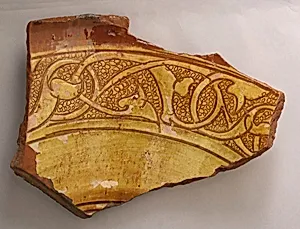
Medium
Earthenware; incised decoration through white slip and coloring under transparent glaze
Classification
Ceramics
Department
Islamic Art
Museum
Metropolitan Museum of Art, New York, NY
Credit
Gift of Ginsberg & Levy, 1921
Accession Number
21.52.10
Rights
Public Domain
Art Historical Context
This exquisite *Fragment of a Dish*, to the 14th–15th century, hails from the vibrant world of Islamic, showcased in the Metropolitan Museum of Art's Islamic Art department. Crafted earthenware, it features masterful technique known as slipware with incised decoration: artisans applied a white slip over the clay body, then incised intricate designs through it to reveal the reddish underlying clay. Vibrant coloring was added before a transparent glaze sealed the surface, creating a luminous, jewel-like effect that was both durable and visually stunning. Produced during a golden age of Islamic pottery in regions like Persia or Syria under Timurid or Mamluk influences, such dishes served both practical and ornamental purposes in households and palaces. The sgraffito-style incision—scratching away layers for contrast—highlighted the potters' precision and creativity, often evoking floral motifs, arabesques, or geometric patterns symbolic of paradise gardens in Islamic art. Though only a fragment survives, it whispers of the era's technical innovation and aesthetic refinement, bridging utility and luxury. A generous gift from Ginsberg & Levy in 1921, this piece invites us to marvel at the anonymous artist's skill, preserved across centuries to connect us with medieval Islamic ingenuity.