
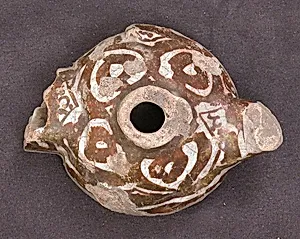
Fragment of a Lamp
Unknown Artist
13th–14th century
Medium
Earthenware; glazed
Dimensions
H. 2 in. (5.1 cm) L. 3 3/4 in. (9.5 cm)
Classification
Ceramics
Department
Islamic Art
Museum
Metropolitan Museum of Art, New York, NY
Credit
Museum Accession
Accession Number
x.211
Rights
Public Domain
Art Historical Context
This delicate fragment of a lamp, crafted from glazed earthenware in the th–14th century offers a glimpse into the refined ceramic traditions of the Islamic world. just 2 inches high and 3¾ inches long, it survives as a testament to everyday objects that blended utility with. Housed in the Metropolitan Museum of Art's Islamic department, this piece reflects the period's mastery of pottery, when artisans across regions like Persia, Syria, and Egypt produced vessels for lighting homes, mosques, and. The use of earthenware—a fired clay body—combined with a glossy glaze was a hallmark technique, providing durability against daily use while allowing for vibrant, reflective surfaces. Lamps held practical and symbolic importance, illuminating spaces during evening prayers or gatherings and evoking the spiritual metaphor of light in Islamic culture. Though incomplete, this fragment highlights the anonymous skill of medieval potters, whose work influenced global ceramics. Visitors will appreciate how such modest artifacts preserve the ingenuity of Islamic craftsmanship, bridging the gap between ancient functionality and timeless beauty.