
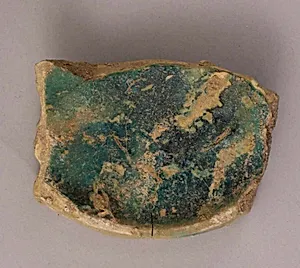
Fragment of a Lamp
Unknown Artist
9th century
Medium
Earthenware; glazed
Dimensions
H. 1 7/8 in. (4.7 cm) W. 2 7/16 in. (6.2 cm) D. 1/4 in. (0.7 cm)
Classification
Ceramics
Department
Islamic Art
Museum
Metropolitan Museum of Art, New York, NY
Credit
Gift of Noel E. Baker, 1952
Accession Number
52.130.9
Rights
Public Domain
Art Historical Context
This delicate fragment of a 9-century glazed earthenware lamp offers a glimpse into the everyday artistry of the Islamic world during the Abbasid Caliph's golden age. Measuring just under 2 inches wide and less than 2 inches high, it once formed part of a functional oil, likely used in homes, mosques, or across the vast Islamic empire stretching from Spain to Central Asia. The thin profile (only a quarter-inch deep) highlights the potter's skill in creating lightweight yet durable vessels. Glazed earthenware was a hallmark of early Islamic ceramics, with the glossy coating not only enhancing beauty through vibrant colors and shine but also making the surface impermeable to liquids—essential for lamps holding olive oil and wicks. This technique, refined in Mesopotamian and Persian workshops around Baghdad, marked a technological leap from unglazed pottery, blending utility with subtle elegance often featuring abstract motifs in compliance with Islamic aniconism. Preserved through the generous gift of Noel E. Baker in 1952, this piece in the Metropolitan Museum of Art's Islamic Art collection reminds us how even humble fragments illuminate a sophisticated culture's ingenuity and aesthetic sensibility. Visitors can appreciate how such objects bridged the practical and the poetic in medieval life.