
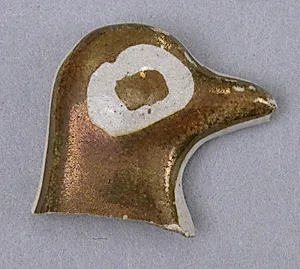
Fragment of a Luster Bird
Unknown Artist
10th century
Medium
Earthenware; luster-painted on opaque white glaze
Dimensions
H. 1 in. (2.5 cm) W. 1 1/8 in. (2.9 cm) D. 5/16 in. (0.7 cm)
Classification
Ceramics
Department
Islamic Art
Museum
Metropolitan Museum of Art, New York, NY
Credit
Gift of Michel E. Abemayor, 1971
Accession Number
1971.103
Rights
Public Domain
Tags
Art Historical Context
This delicate fragment, known as *Fragment of auster Bird*, hails from the 10th century showcases the pinnacle of Islamic ceramic artistry. Crafted from earthenware and adorned with luster-painted designs over an opaque white glaze it measures just 1 inch high—a testament to the miniaturist's. Likely part of a larger vessel, the bird motif evokes the natural world so revered in Islamic decorative arts,izing grace and the gardens of paradise. Lusterware a revolutionary technique perfected in the Abbasid era, involved applying metallic oxides to the glazed surface and firing it in a reducing atmosphere to produce a shimmering, iridescent glow reminiscent of gold and silver. This innovation, originating in the Islamic world around the 9th century, influenced ceramics across Europe and beyond. Though only a shard survives, it captures the era's technical mastery and aesthetic refinement, blending functionality with opulent beauty. Today, this tiny treasure resides in the Metropolitan Museum of Art's Islamic Art Department, a gift from Michel E. Abemayor in 1971. It invites visitors to marvel at how ancient artisans transformed everyday clay into luminous poetry.