
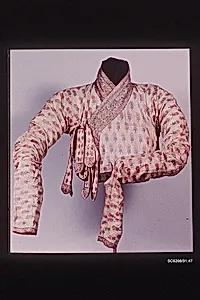
Fragment of a Robe (Jama)
Unknown Artist
ca. 1628–58
Medium
Cotton, silk; plain weave, embroidered
Dimensions
Textile: L. 19 1/2 in. (49.5 cm) W. 90 1/2 in. (229.9 cm)
Classification
Textiles-Costumes
Department
Islamic Art
Museum
Metropolitan Museum of Art, New York, NY
Credit
Rogers Fund, 1931
Accession Number
31.47
Rights
Public Domain
Art Historical Context
This elegant fragment of a jama, or robe, dates to the mid-17th century during the height of the Mughal Empire in India. Woven from fine cotton and embroidered with silk threads, the garment would once have formed part of the flowing attire worn by members of the imperial court. Its surviving panel, measuring nearly eight feet in width, hints at the luxurious scale of such garments, which were designed to drape gracefully over the body. The embroidery features delicate floral motifs, a hallmark of Mughal textile design that celebrated the natural world and imperial gardens. Worked in a plain-weave ground with intricate surface stitching, the piece showcases the technical mastery of anonymous artisans who combined lightweight cotton with shimmering silk for both comfort and visual splendor. Such robes served not only as clothing but also as symbols of status and refined taste within courtly circles. Acquired by the Metropolitan Museum in 1931, this fragment offers a rare glimpse into the opulent material culture of the period. Its floral patterns reflect broader artistic traditions that valued harmony between human craft and nature, making it a treasured example of Islamic textile artistry.