
Fragment of a Shoulder Band
Unknown Artist
6th century
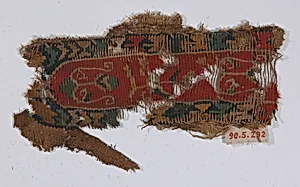
Medium
Wool, linen; plain weave, tapestry weave
Dimensions
Max. H. 4 3/4 in. (12.1 cm) Max. W. 1 5/8 in. (4.1 cm)
Classification
Textiles
Department
Islamic Art
Museum
Metropolitan Museum of Art, New York, NY
Credit
Gift of George F. Baker, 1890
Accession Number
90.5.292
Rights
Public Domain
Art Historical Context
This delicate *Fragment of a Shoulder Band from the 6th offers a glimpse into the sophisticated textile traditions of the early Islamic world. Crafted from wool and linen, this tiny survivor—measuring just 4 3/4 inches high and 15/8 inches wide—was likely part of a garment's decorative shoulder strap, adorning tunics or shawls worn in daily life or for special occasions. Housed in the Metropolitan Museum Art's Islamic Art Department, it entered the collection as a gift from George F. Baker in 1890, preserving a piece of history from a time when weaving bridged Late Antique and emerging Islamic cultures across the Near East and Egypt. The fragment showcases masterful techniques: a plain weave ground, probably linen for durability, overlaid with vibrant tapestry weave in wool for patterned motifs. Tapestry weaving, where colored weft threads completely cover the warp, allowed artisans to create bold, durable designs without complex looms—ideal for portable, intricate decoration. These methods highlight the era's skilled craftsmanship, where textiles served as wearable art, conveying status and cultural identity. Though small, this fragment underscores the cultural significance of textiles in 6th-century societies, often buried with the deceased and thus surviving millennia. It reflects the continuity of decorative traditions that would flourish in Islamic art, blending functionality with beauty in everyday finery.