
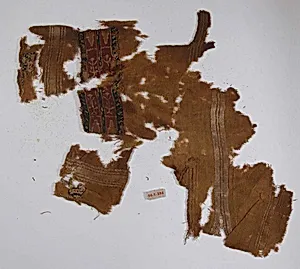
Fragment of a Sleeve
Unknown Artist
5th–6th century
Medium
Wool, linen; plain weave, tapestry weave
Dimensions
Max. H. 6 11/16 in. (17 cm) Max. W. 5 1/8 in. (13 cm)
Classification
Textiles
Department
Islamic Art
Museum
Metropolitan Museum of Art, New York, NY
Credit
Gift of George F. Baker, 1890
Accession Number
90.5.294
Rights
Public Domain
Art Historical Context
This delicate *Fragment of a Sleeve*, dating to the 5th–6th century, offers a rare glimpse into the everyday textiles of the early Islamic world. Crafted from wool and linen using plain weave for the foundation and tapestry weave for decorative patterns, this small piece—measuring just 6 11/16 by 5 1/8 inches—was likely part of a garment worn in the bustling trade hubs of the Near East or Egypt. Donated to the Metropolitan Museum of Art in 1890 by F. Baker, it resides in the Islamic Art, highlighting the museum's commitment to preserving fragile fabrics from antiquity. The dual weaving techniques showcase sophisticated craftsmanship: plain weave provided sturdy, breathable cloth ideal for clothing, while tapestry weave allowed artisans to create vibrant, pictorial motifs by interweaving colored wefts. Such methods were labor-intensive, often produced in workshops that blended local traditions with influences from Byzantine, Sasanian, and Coptic cultures, reflecting the interconnected Silk Road networks. As a survivor of centuries, this fragment reveals the cultural richness of pre-Islamic societies in regions that shaped Islamic art. It whispers of fashion, status, and skilled hands, inviting us to imagine the person who once slipped their arm through this sleeve amid the sands of history.