
Fragment of a Sleeve
Unknown Artist
5th century
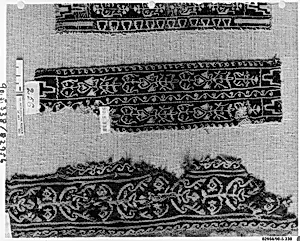
Medium
Wool, linen; plain weave, tapestry weave
Dimensions
Max. H. 7 13/16 in. (19.8 cm) Max. W. 1 15/16 in. (5 cm)
Classification
Textiles
Department
Islamic Art
Museum
Metropolitan Museum of Art, New York, NY
Credit
Gift of George F. Baker, 1890
Accession Number
90.5.338
Rights
Public Domain
Art Historical Context
This delicate *Fragment of a Sleeve* the 5th century a tantalizing glimpse into ancient textile artistry, preserved in the Metropolitan Museum of's Islamic Art Department.ed from wool and linen plain weave for the foundational structure and tapestry weave for elements, this narrow strip measures just 7 13/16 inches high and 1 15/16 inches wide.ated in 1890 by George. Baker, it exemplifies fragility and rarity of surviving garments from late antiquity, when such fabrics adorned everyday clothing in regions bridging the Mediterranean and Near East. The combination of plain weave—simple yet sturdy, ideal for durability—and tapestry weave, which allowed for intricate patterns through discontinuous wefts, highlights sophisticated weaving techniques. These methods were labor-intensive, often produced by skilled artisans in workshops, reflecting cultural values placed on finely crafted attire. Though the artist remains unknown, the fragment's presence in the Islamic Art collection underscores its role in the continuum of textile traditions that influenced later Islamic designs, from Egypt to Persia. As a humble sleeve remnant, it invites us to ponder the lives of its long-ago wearers—perhaps a laborer or merchant—while celebrating the enduring allure of textiles as some of humanity's oldest art forms. Such pieces remind us how even fragments can weave rich historical tapestries.