
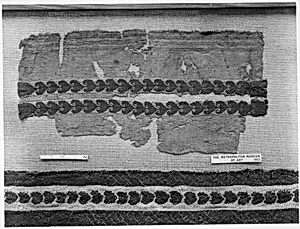
Fragment of a Sleeve
Unknown Artist
3rd–4th century
Medium
Wool, linen; plain weave, tapestry weave
Dimensions
Max. H. 10 3/4 in. (27.3 cm) Max. W. 5 3/16 in. (13.2 cm)
Classification
Textiles
Department
Islamic Art
Museum
Metropolitan Museum of Art, New York, NY
Credit
Gift of George F. Baker, 1890
Accession Number
90.5.512
Rights
Public Domain
Art Historical Context
This delicate fragment of a sleeve, dating to the 3rd–4th century, offers a glimpse into the everyday artistry of early textile production in the ancient Near East or Mediterranean world. Housed in the Metropolitan Museum of Art's Department of Islamic Art, this small piece—measuring just 10¾ by 5⅛ inches—was generously gifted by George F. Baker in 1890. Though attributed to an unknown artist, exemplifies the sophisticated craftsmanship of Late Antique societies, where textiles served not only practical purposes but also as canvases for cultural expression. Crafted from wool and linen using plain weave for the base and tapestry weave for decorative elements, the fragment highlights advanced weaving techniques. Plain weave provided a sturdy, breathable foundation ideal for garments, while tapestry weave allowed for intricate patterns woven directly into the fabric, creating vibrant motifs without additional sewing. Such methods were labor-intensive, often produced in workshops, and reflect the era's trade networks linking Egypt, Syria, and Persia. As a rare survivor from over 1,600 years ago, this sleeve fragment underscores the cultural importance of textiles in pre-Islamic and early Islamic contexts. Clothing fragments like this reveal fashion, social status, and technological innovation, bridging the gap between ancient daily life and the opulent traditions preserved in the Met's collection. Visitors can marvel at how such humble remnants illuminate a vibrant, interconnected world.