
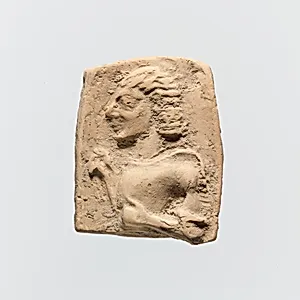
Fragment of a terracotta plaque
Unknown Artist
7th century BCE
Medium
Terracotta
Dimensions
2 3/8 in. x 2 in. (6 cm x 5 cm)
Classification
Terracottas
Culture & Period
Greek, Cretan · Archaic
Department
Greek and Roman Art
Museum
Metropolitan Museum of Art, New York, NY
Credit
Gift of the Archaeological Institute of America, 1953
Accession Number
53.5.17
Rights
Public Domain
Tags
Art Historical Context
This delicate fragment of a terracotta, hailing from 7th-century BCE Crete during the Archaic period, a glimpse into ancient Greek on the island. Measuring just 2 3/8 by 2 inches, it likely originated from a larger votive plaque dedicated at a sanctuary, a common practice in Cretan religious life. The tag "Boys" hints at youthful figures, possibly worshippers or participants in rituals, reflecting the cultural emphasis on youth, fertility, and community devotion in Archaic Greece. Crafted from terracotta—fired clay valued for its affordability and durability—this piece showcases early techniques of molding and low-relief modeling. Cretan workshops during this era blended local traditions with emerging Orientalizing influences, producing plaques that adorned sacred spaces. Though incomplete, it exemplifies the period's shift toward more naturalistic forms, bridging Geometric abstraction and the classical ideals to come. Today, gifted to the Metropolitan Museum of Art by the Archaeological Institute of America in 1953, this tiny artifact underscores Crete's pivotal role in Greek art's evolution, inviting us to ponder the lives of those long-ago boys captured in clay.