
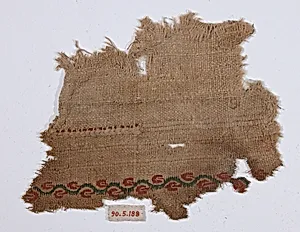
Fragment of a Tunic
Unknown Artist
5th century
Medium
Wool, linen; plain weave, tapestry weave
Dimensions
Max. H. 6 11/16 in. (17 cm) Max. W. 5 5/16 in. (13.5 cm)
Classification
Textiles
Department
Islamic Art
Museum
Metropolitan Museum of Art, New York, NY
Credit
Gift of George F. Baker, 1890
Accession Number
90.5.188
Rights
Public Domain
Art Historical Context
This delicate fragment of a tunic, to the 5th century, offers a rare glimpse into the everyday artistry of ancient textile makers. Crafted from wool and linen using plain weave for the sturdy base and tapestry weave vibrant patterns, it measures just 6 11/16 by 5 5/16 inches—small enough to fit in your hand, yet rich with historical resonance. Housed in the Metropolitan Museum of Art's Islamic Art department as a gift from George F. Baker in 1890, it exemplifies the fragility and endurance of ancient fabrics. Tapestry weave, a technique where colored weft threads are woven directly into the fabric to create motifs, allowed artisans to produce durable, pictorial designs without relying on dyes that might fade. In the 5th century, such textiles were essential for clothing like tunics, worn across diverse cultures in the Near East and North Africa. This fragment likely survived from a garment used in daily life or burial, highlighting the skill of anonymous weavers who blended functionality with subtle decoration. As a survivor from over 1,500 years ago, it underscores the cultural importance of textiles in pre-Islamic societies, where clothing conveyed status and identity. Though incomplete, it invites us to ponder the hands that wove it, preserving a thread of human creativity for modern eyes.