
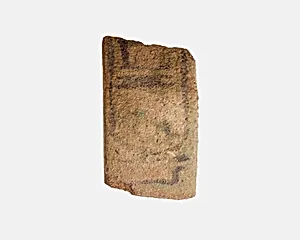
Fragment of a votive bracelet
Unknown Artist
ca. 1295–1070 B.C.
Medium
Faience
Dimensions
H. 4.3 × W. 2.6 × Th. 0.7 cm (1 11/16 × 1 × 1/4 in.)
Classification
Votive bracelet
Period
New Kingdom, Ramesside
Department
Egyptian Art
Museum
Metropolitan Museum of Art, New York, NY
Credit
Gift of Egypt Exploration Fund, 1909
Accession Number
09.182.19.13
Rights
Public Domain
Art Historical Context
This delicate fragment of a votive hails from Egypt's New Kingdom, during Ramesside period of Dynasties 19–20 (ca. 1295–1070 B.C.), a age of pharaonic power under rulers like Ramesses II. Votive objects like this were crafted as offerings to the gods, often worn as jewelry before being dedicated in temples as acts of piety or gratitude. Though only a small piece survives—measuring just 4.3 cm high—this artifact whispers of personal devotion amid the era's grand monuments and military triumphs. Made of faience, a signature Egyptian material of crushed quartz glazed to mimic semiprecious stones like turquoise or lapis lazuli, it showcases the ancient artisans' mastery of low-fired ceramics. Faience's vibrant, glossy finish made luxury accessible to all social classes, blending technical innovation with aesthetic brilliance. Its thin profile (0.7 cm) hints at the precision required for wearable adornments. Housed in the Metropolitan Museum of Art's Egyptian Art department, thanks to a 1909 gift from the Egypt Exploration Fund, this fragment invites us to ponder the spiritual lives of everyday ancient Egyptians. Though incomplete, it endures as a testament to their enduring faith and craftsmanship.