
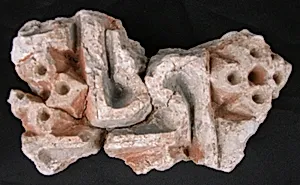
Fragment of a Wall Decoration
Unknown Artist
10th–11th century
Medium
Plaster; carved and painted
Dimensions
40.170.680a: H. 6 3/8 in. (16.2 cm) W. 3 11/16 in. (9.4 cm) D. 2 1/4 in. (5.7 cm) Wt. 11.4 oz. (323.2 g) 40.170.680b: H. 6 5/16 in. (16 cm) W. 3 3/8 in. (8.6 cm) D: 1 15/16 in. (4.9 cm)
Classification
Plaster
Department
Islamic Art
Museum
Metropolitan Museum of Art, New York, NY
Credit
Rogers Fund, 1940
Accession Number
40.170.680a, b
Rights
Public Domain
Art Historical Context
This delicate fragment of a decoration, dating to the 10th–11th century, exemplifies the artistry of Islamic architectural ornamentation. Crafted from plaster that has been intricately carved and painted, consists of two small pieces (accession numbers 40.170.680a and b), roughly 6 inches high and 3–4 inches wide. These dimensions hint at their origin as parts of a larger interior panel, likely adorning the walls of a mosque, palace, or elite residence in the Islamic world. Plasterwork like this was a hallmark of medieval Islamic design, prized for its versatility and affordability compared to stone. Artisans skillfully carved motifs—often geometric patterns, arabesques, or floral elements—before applying vibrant paints, creating a luminous effect in dimly lit spaces. This technique flourished during the Fatimid and Abbasid eras, blending technical precision with spiritual symbolism, where decoration evoked paradise gardens without figurative representation. Preserved through the Rogers Fund in 1940, this piece at the Metropolitan Museum of Art offers a tangible glimpse into everyday splendor of Islamic culture, reminding us how everyday materials could transform spaces into realms of beauty and contemplation.