
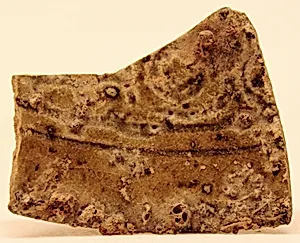
Fragment of a Waster
Unknown Artist
11th–12th century
Medium
Stonepaste; white body, molded, incised and pierced under celadon-green glaze
Dimensions
H. 2 1/4 in. (5.7 cm) W. 1 7/8 in. (4.8 cm) D. 7/16 in. (1.1 cm) Wt. 0.4 oz. (11.3 g)
Classification
Ceramics
Department
Islamic Art
Museum
Metropolitan Museum of Art, New York, NY
Credit
Rogers Fund, 1948
Accession Number
48.101.46
Rights
Public Domain
Art Historical Context
This delicate fragment, known as a "waster," hails from Islamic world of the 11th–12th century and offers a glimpse into the experimental workshops of medieval potters. A waster is a discarded piece damaged during production—likely cracked in the kiln—preserving techniques that might otherwise be lost. Housed in the Metropolitan Museum of Art's Islamic Department, this tiny stonepaste shard (just over 2 inches high) exemplifies the ingenuity of artisans in regions like Iran or Syria, where ceramic innovation flourished amid Silk Road exchanges. Crafted from a white stonepaste body—a composite of quartz, clay, and frit that mimicked the translucency of coveted Chinese porcelain—the fragment was molded into shape, then intricately incised with carved lines and pierced with precise holes before glazing. The celadon-green glaze, a soft, jade-like hue inspired by East Asian imports, not only protected the surface but enhanced its luminous quality, firing to a subtle sheen. These labor-intensive methods highlight the technical prowess of Islamic ceramists, who pushed boundaries in opacity, durability, and decoration long before Europe's porcelain era. Though incomplete, this artifact whispers of opulent tableware or architectural tiles, underscoring ceramics' role in daily life and luxury trade. Acquired through the Rogers Fund in 1948, it invites us to appreciate the unsung failures that reveal a golden age of artistry.